Recently the BS-o-meter of many forum members was tripped by a guy claiming to get 110 mpg out of his 1987 Ford Mustang. Though the claim seems a little ridiculous, and I think most people would be quick to dismiss it, the fact that it’s getting some media attention warrants a debunking.
The first thing to say is that conspiracy theories will not be considered here. I am not on the payroll of big oil, the government, Saudis, terrorists, or any of that. Nor is there any real evidence that any of these agents are going above and beyond normal business tactics to keep the US addicted to oil. Sure, the Saudis may produce more oil to lower prices and make the need for alternatives less pressing, but is Exxon assassinating the “water4gas” internet spammers? I think not. So, if your argument for the feasibility of this device is that it’s always been possible and the man is keeping it down, then don’t waste your breath arguing.
Now on to this specific case. Here we have a mechanic named Doug Pelmear with an ‘87 Ford Mustang that he claims gets 110 mpg, 400 horsepower, 500 ft-lbs of torque, and can do 0-60 in 3 seconds. According to Doug, the builder:
“My grandfather had the idea back in the 40’s that he can make a difference then,” Pelmear says, “There was quite a need at that time also with the war going on and everything, there was quite the need then.” And quite a need now.
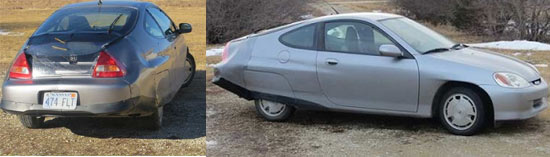
This should throw up our first red flag. His grandfather had an idea back in the 40s that this guy has remade into some sort of miracle device 60 years later? Nevermind the fact that automakers spend billions of dollars working on having the best of the best in terms of both power and efficiency, and that to date the Honda Insight holds the mileage crown at with a combined EPA rating of 53 MPG. Doug Pelmear claims to more than double that using something his grandfather thought up 60 years ago? Engine technology from that period is nothing like the fuel injected, computer controlled tech of today, but this device still works wonders?
Those this technology could be working to increase the thermodynamic efficiency of the engine, as one ecomodder pointed out, thermodynamic efficiency can only be increased so much before it is at 100%, which would be impossible. Given that car engines are typically 25-30% efficient, there is only so much gain to be had before you’re claiming to have broken the laws of physics.
As for the car itself, 1987 Mustangs come with EPA ratings from 17-24 MPG, with 17 being the number assigned to the V8 variety. Completely disregarding the performance claims Doug is making, if we are to assume he’s using the 5.0L V8 as a base, he’s claiming a 640% increase in fuel economy. While ecomodders regularly report increases of 50% to 100% on the extreme side, does such a huge improvement seem feasible? And if so, how could it be done while dramatically increasing power output?
The next red flag comes up when we learn that Doug won’t tell anyone what he’s done to the car or what technology he’s using:
While Pelmear won’t let us look under the hood, he says the technology can easily be applied to smaller engines for even better gas mileage. He’s entering the car in the prestigious Progressive Automotive X competition; a race where inventors from around the world compete for the best mileage with a car that is the most marketable. Pelmear says, his technology is very marketable because it will allow people to drive large cars and SUV’s without sacrificing gas mileage.
As the original report notes, the X-Prize is a prestigious competition, but to me it seems like he is only using the name in order to make his claims appear more legitimate. While his plan to sell his design to automakers in order to make it big certainly could explain why he wouldn’t want to make a DIY and post it online, but he can’t expect anyone to believe his claims if he’s not even willing to drive the car around and fill it up at the pump to throw a little weight behind his claims.
And even that brings up another question. Evidently Doug’s job was recently cut in Ford’s latest round of lay-offs. If he intends to use this invention to bring back the US automotive industry, why didn’t it see the light of day during the years he worked for billion-dollar manufacturer? This kind of technology would have definitely gotten him a nice promotion, a fat paycheck, and position as the savior of his company. Instead, he doesn’t mention until he’s out of a job.
If you watch this video from CNN, you will see a few more interesting things:
The first thing that I notice is that he’s running (or at least claiming to run) E85. While E85 is higher octane, it is also known for returning lower fuel economy in flex-fuel vehicles. Wikipedia notes that the flex-fuel Chevy Tahoe is rated for 18 mpg with regular gasoline, but only 13 mpg using E85. That’s 38% less fuel economy in a vehicle designed to run on E85.
Secondly, when the 110 mpg image pops up, you’ll note that it actually says “MPGe.” This stands for “miles per gallon energy equivalent,” which, coupled with the knowledge that he is running E85 suggests that he is getting less that 110 mpg and using a conversion factor to make the number sound more impressive than it otherwise would. Using the previous Chevy Tahoe example as an analogy, this means that he might only be getting 80 mpg while deceptively claiming 110 mpg. Though his website does show “MPGe” and state that it means “energy equivalent,” he neither explains this to readers nor to the reporter. This, at least, seems as if he is trying to mislead us and makes me question his other claims.
Finally, you’ll notice that even though the two men behind the scenes are talking up the performance of this car, we only see it peacefully cruising the neighborhood streets. Were the reporters to daft to ask for a ride or is that another one of Doug’s secrets? Surely a muscle car like that would be capable of a few burnouts or revs to show off for itself. However, we’re left knowing nothing more than that it actually runs under its own power.
In the end, Doug Pelmear doesn’t give us any reason to believe his claims. All his website states is that on the 14th of June the car will be tested at a race track. Sadly, that was posted on the 16th of June, and there were never any results. There are plenty of reasons to believe this is nothing more than a fuel price-related scam cooked up by someone pissed off that he got fired from his job at Ford, and unless there is some great revelation, I’m calling this a hoax. As always, feel free to disagree.
If you liked this post, sign up for out RSS Feed for automatic updates.
It may not be surprising that any politician from Illinois, the United States’ second largest corn-producing state, supports ethanol, but in Senator Obama’s case, this does come as a bit of a shock. I don’t like to inject EcoModder into political discussions very often, but when it comes down to our possible future president and his views on ethanol as a future fuel source, it’s important that we all be informed.
The reason I say that I am a little shocked by Obama’s support of ethanol is that, however you feel about the man, you have to admit he is usually aware of the popular opinion held by those considered to be experts of whatever field. Those experts, at least the ones concerned with the economy and the environment, tend to believe that corn-based ethanol production isn’t exactly a winner. The main supporters of corn-based ethanol are, after all, farm lobbyists. One just doesn’t expect Obama, with his strong stances on lobbyists and special interests, to be one to buy into the mega-farm corn lobbying.
Mr. Obama is running as a reformer who is seeking to reduce the influence of special interests. But like any other politician, he has powerful constituencies that help shape his views. And when it comes to domestic ethanol, almost all of which is made from corn, he also has advisers and prominent supporters with close ties to the industry at a time when energy policy is a point of sharp contrast between the parties and their presidential candidates.
As far as policy is concerned, Obama’s support for ethanol is based primarily on foreign policy and security concerns, not environmental ones. Supporting ethanol, he believes, is a way to divest money and interest from foreign and often hostile powers. With that money staying home not only will the US have greater energy independence, but will send less of its money abroad.
Senator McCain, on the other hand, is a staunch supporter of free trade and wants to end tariffs on foriegn ethanol as well as end subsidies to the US ethanol industry. Sure, McCain’s recent plan to secure $300 million for EV batteries doesn’t exactly smack of free trade, but he certainly doesn’t seem to believe in corn ethanol as a solution to the brewing energy crisis.
You can’t fault McCain for being inconsistent on ethanol, at least, because it seems he’s opposed it since longer than most of us knew about it, dating back to his failed 2000 primary election bid.
So where does this leave voters, people interested in the environment, economics, and the future of transportation in the US? While I have no interest in telling you who to vote for, it’s clear that even though McCain and Obama share the goal of energy independence and greenhouse gas reductions, they intend to go about it in very different ways. It is, in my view, not very likely that either candidate will be changing their opinions anytime soon.
While Obama will continue to support government intervention and ethanol, and McCain the opposite, it is also true that either individual, as President, will need to make compromises on their positions in order to create effective policy. It is here that all citizens, regardless of political affiliation, have the ability to influence the policy makers. My advice: vote for who you like and support the views you find important, because it doesn’t have to end at the ballot box.
If you liked this post, sign up for out RSS Feed for automatic updates.
That’s right, EcoModder is going to be at this year’s Hybrid Fest! On July 19th& 20th I will be holding down the fort in Madison, Wisconsin. That’s quite a drive for me (925 miles from my home in NJ), but I think it will be worth it in order to hang out with some more people interested in green cars and new technology.
EcoModder will have its own booth, where we will show my CRX and Ben Nelson’s electric motorcycle. At the booth you’ll also be able to find information on ecomodding, ecodriving, and other highly modified cars. If you’re at all interested in something a little different, you should definitely come check us out.
You can find the schedule of activities here, but I think the most promising one will be the MPG competition the day before the official start. I don’t know if I’ll be able to participate because of my drive across country to get there, but look forward to reporters from co-founder Darin Cosgrove and my own fuel economy reports from the trip there.
If you liked this post, sign up for out RSS Feed for automatic updates.
A year ago, EcoModder forum member Ben Nelson got an old, non-running motorcycle and converted it to electric drive. He’d never had a motorcycle before and wasn’t an expert with electric vehicles, but in true DIY nature, he learned as he went along.
The bike was never designed to be a fast, flashy race bike, but rather a cheap and effective way to get around town in style. Ben is currently building an electric car, but by all accounts a motorcycle is a great (and slightly less expensive) step down the road to electric vehicles. In the end Ben had built himself a motorcycle with speed up to 40 mph and a range of around 15 miles, all for less than $2000. The best thing about the conversion is that, unlike many, it is completely street legal, with full registration and insurance.
Here’s what Ben has to say about the costs of this project:
$100 for original cycle
$500ish for motor (used on Ebay)
$300ish for New Alltrax AXE 48v 300 amp programmable controller
$160 EACH for 4 Optima yellow top 55AH batteries.
I am also including in this total cost, a motorcycle safety class, new helmet, a year of insurance, lots of little trips to the hardware store, etc.
So, the total cost for the bike was really only about$1500, with a few new parts (like the controller) that could’ve been found used if you’re running on a tighter budget. Currently, the bike is only using three of those four batteries, as Ben is trying to find out how to mount the 4th battery and up the bike to 48 volts.
Comparing the energy content of gasoline to that used by the motorcycle, Ben’s determined that on average, his bike gets the equivalent of 300 mpg:
This shows that not only is the electric version more efficient, but if you crunch the numbers comparing the current price of gas to the price of grid energy, you’ll see that this motorcycle is not only cool and environmentally friendly, but has the potential to save a bit of money. For more info on eMPG, check out this thread.
However, Ben’s story isn’t all gumdrops and happy endings. One day, while out riding the motorcycle he managed to blow up the controller. He and the bike are fine and he’s got it going again, but when attempting a DIY project like this, especially because it involves a vehicle responsible for your safety, it’s always good to go in with open eyes and be ready for the unexpected. That said, it wasn’t as dramatic as it sounds.
Besides being a great ecomodder, Ben is also pretty good with video. Check out these two that he put together, the first one is his neighbor’s reaction to the electric bike and the second is Ben talking about the project:
For more depth about the building and the tech specs behind this bike, check out Ben’s site and his build thread. More inspiration for EV motorcycles can be found at the motorcycle section of the Austin EV album. You can even find Ben’s bike on there.
UPDATE: I talked to Ben and he told me that he had in fact added the forth battery, and that with that and the system running 48v his top speed has been increased to 45 mph and the range to 20 miles. Sorry for the error!
If you liked this post, sign up for out RSS Feed for automatic updates.
A few months ago Daimler reported that they were testing 100 electric versions of its Smart car in London, and that if all went well they would work on putting the car into production for the general population to buy. Well, now Daimler CEO Dieter Zetsche has said that all did go well. This means that the company will release its EV Smart in 2010, the same year the Chevy Volt is scheduled to come out.
Personally, I find it funny that Daimler can go from no electric car to a firm release date so easily and with so little fanfare, while the blogosphere seems poised to trip over every word that comes out of Bob Lutz’s mouth about the not-even-EV Chevy Volt. But, that’s really a story for another post.
No price has yet been released for the EV to be. Because the Smart is known not only as a fuel efficient car, but a cheap car, Daimler is deciding whether it wants to sell the batteries with the car or lease them. Leasing has the advantage of a lower up-front cost, but will also mean continued cost of ownership.
Also, no mention was made of whether or not the Smart EV would be released in the US. Seeing as how the car just made the jump across the pond, it’s likely that the first incarnation will be a Europe-only affair.
If you liked this post, sign up for out RSS Feed for automatic updates.
If you haven’t noticed, people aren’t exactly keen on driving trucks and SUVs these days. This isn’t just affecting commuters, but also city governments, businesses, and truckers. Just last month the F150 finally fell from it’s position as the best-selling vehicle in the US, and now it’s come out the Ford is delaying the release of the iconic truck.
Originally, production of the 2009 F150, a highly anticipated redesign, was supposed to begin production this month. According to Edmunds, however, that production schedule has now been pushed back two months until August and September. This is amid news from Ford that the company will be scaling back its production of trucks and SUVs while working on a more fuel efficient vehicle lineup.
Ford will be rereleasing it’s Fiesta subcompact, to be built in Mexico, in 2010. Ford also plans to update its popular compact car, the Focus, so that it is common with the European model. The 2011 Focus will not only be redesigned, but should get much better mileage as the company looks to compete with the Honda Civic and Toyota Corolla.
If you liked this post, sign up for out RSS Feed for automatic updates.
Even though you may remember the US version of the Suzuki Swift as the nerd-chic Geo Metro or Pontiac Firefly, the rest of the world currently thinks about the car as that sweet looking subcompact owned by the family down the street. This current incarnation was released in Japan and Europe in 2004, and as reported by ABG, recently passed the 1 million sale mark.
The car started out in Japan, but quickly moved to Europe, where it is built in Hungary, and recently to the UK, where sales are strong. Judging by Suzuki’s advertising push in the US recently, combined with the high price of gas and the resurgence of compact cars, I really wonder if we’ll see this car on our side of the pond any time soon.
If you liked this post, sign up for out RSS Feed for automatic updates.
Earlier I talked about how March represented a dramatic drop in vehicle miles traveled, but that’s nothing compared to a recent report stating that Americans have cut back 30 billion miles over the last six months. The drop was measured between November 2007 - April 2008, and compared to the same period from a year ago. Overall the drop was only 1%, but compared to an annual increase of 1-2%, the difference from the norm is actually a bit bigger.
The drop is the largest it’s been since the fuel crisis of 1979-1980, and with fuel prices looking to stay high, may represent a permanent change in the way Americans think about travel. Here’s what USA Today has to say about the difference between now and the last fuel crisis (which I wasn’t alive for!):
“It’s not a blip,” said Marilyn Brown, professor of energy policy at Georgia Tech, citing data showing surging transit ridership, dropping sales of sport-utility vehicles and sharply increased demand for gas-efficient vehicles. “I think the difference between now and 1979, when prices were comparable when you adjust for inflation, is there’s a sense of sustained pain. There’s a sense that the era of cheap energy is a thing of the past.”
This comes amid a flurry of TV, magazine, and newspaper stories about people hopping on the bike, moving closer to work, and dumping their gas-guzzling trucks and SUVs at any cost. My experience with change in the US would suggest that the news is exaggerating the reality of the situation, but these new, hard numbers suggest that isn’t the case at all. Even though some aren’t changing their habits at all, enough are doing it to make the largest drop we’ve seen in decades.
+ FE vs. Cargo and Passenger Capacity
+ Fun to Drive (especially handling)
+ Added Feature Content
- Uncomfortable Driving Position
- Hodgepodge of Toyota and GM Parts
- Spartan Interior
“New United Motor Manufacturing Inc.” or NUMMI is printed on stickers under the hood. What’s up with that?
That’s the name given the to the GM/Toyota joint venture in Fremont, CA. The unique situation is the History of a UAW manufacturing agreement between General Motors and Toyota, at a facility that has produced Union-made vehicles, such as the:
Chevy Nova (1984-1988)
Geo/Chevy Prizm / Toyota Corolla (1998-2002)
Pontiac Vibe / Toyota Matrix (2003-Present)
…and other vehicles exported abroad.
Background: The Pontiac Vibe and Toyota Matrix were introduced in 2003 as a compact wagon to provide an answer to those looking for a performance-oriented Corolla Wagon, or a domestically-nameplated, small utility vehicle. The secret? Essentially a tall, extended Corolla with GM parts (radio, miscellaneous parts, etc.) + great FE to boot. Now, a 2009 variant is available with a sleek makeover. This review examines the Pontiac Vibe, along with the Toyota Matrix. The latter is available with different outward styling and a near-identical interior, in the 2003-2008 model run.
2008 Toyota Matrix
The First Generation model was introduced about 6 model-years ago. The problem is this: I rented several of both variants over the course, and the FE wasn’t stellar.
Confession: Hypermiling rehab is a slow and steady process. I used to set the cruise for 6-7 MPH over the limit. That ended up being 77 in a 70. With the A/C running in the summer, the transmission was quick to downshift on modest hills, and was quite erratic. The FE suffered terribly. I gave it a shot at the speed limit and no more…
This was the only 4-cylinder vehicle available on the rental lot this week (mid-week slim-pickins). I hopped-in and gave it another try. Nowadays, I set the cruise for the limit and just let it ride. That made all the difference in the World.
On the Inside: The vehicle accomplishes so much in its totality, that I refuse to stress minor inconsistencies. The interior trim is basic and plasticky, but who cares? The look and substance exudes durability, and the FE seals the deal.
Feature content includes a 115V inverter to plug-in AC items (for me — perfect: I’m too cheap to buy an i-Pod, so I use my laptop as an MP3 player and pipe the sound through the speakers through an FM transmitter). Some vehicle models offer an auxiliary input (not in this case). But hey, rock on…
The cargo area is where this vehicle shines brightly. The rear seats fold flat (including the front passenger seat) to allow the transport of long items. It’s a true wagon, so expect that sort of utility (and appearance).
From the driver’s seat, expect a “love it or hate it” Corolla-like seating position, and a 4-pod dash. Rear seat passengers may find the legroom cramped if adults are passengers. If kids are the ride-alongs, then it’s perfect — no worries.
On the Outside: The Toyota is more streamlined and Sporty, while the Pontiac displays durability and simple functionality. My test model offered foglamps, a rear wiper, and side skirts. Just speculation: later models seem to offer better aero than previous.
The Drive: Seating position is perhaps the weakest link. Think: SUV height and feel. I had no problem setting the seat to a higher height, moved the seat back and adjusted the tilt wheel. The problem is, some drivers may find this uncomfortable. I’m not at all tall, at 5′ 9″, with short legs. The position wasn’t too bad — although the ideal setup prohibited viewing the top of the instrument cluster through the wheel top (duck-n-view). If you’re unsure of this seat, visit a dealer and give it a shot (the Corolla is very similar).
Cubbies and cupholders abound. Handling is sprite, as is throttle response and acceleration. If you keep the speed down, downshifts are infrequent, and the FE total will thank you. At 60, the engine turns at about 2500. Road noise is adequate, and blind-spots minimal.
Features: The Toyota is more “upscale” in outward appearance. A 5-speed or 6-speed manual is available, as is a higher horsepower 1.8L and/or AWD (up to 2007). The Pontiac has similar amenities available.
Used Analysis: A 2003 Vibe 5-speed can be picked-up for $8K, on upwards to a fully loaded ‘08 Matrix XRS for 22K. The vehicle essentially hasn’t changed since its inception, so you can get the same feature content at a reduced price when purchasing used. In addition, Edmunds.com rated the Matrix/Vibe a “Used Car Best Bet” for reliability, etc.
Vehicle Specs as Tested:
Latest Model: 2008 Toyota Matirix / Pontiac Vibe
Trim: Base
Class Size: Compact Wagon
Transmission: 4-speed automatic with lock-up torque converter (5-speed Manual Available)
Engine: Toyota 1.8L DOHC, 16-Valve, I-4 with Variable Valve Timing
Rating: 126 hp at 6000 RPM and 122 lb-ft torque at 4200
Drivetrain: FWD (AWD available)
Seating Capacity: 5 (very snug) at 2+3 or 4 more comfortably at 2+2
Price as Tested: $17,000 USD (April, 2008)
Curb Weight: 2700 lbs.
EPA: 21/31
EPA Average Fuel Cost per Year: $1554
Raw Data — Stats:
EcoModder Tested Mileage: 35.5 MPG
Average Speed: 57 MPH
Distance Driven: 455 Miles
Engine RPM @ 60 MPH: 2500
Route: Kansas City - Wichita, KS - Kansas City (hit rush hour on the return)
Temp: 40F - 55F
Wind Speed vs. Heading: NW @ 5 MPH. Course 1 = SSW; Return = NNE
2009: Complete Re-design
Conclusion: Brilliant!
If you liked this post, sign up for out RSS Feed for automatic updates.
Okay, so maybe the car itself won’t be coming back from the dead, but it’s very possible the name is. ABG reports that even though the Insight will not be coming back to Honda showrooms, the name might be. The coming years will be big for both Honda and Toyota, with lots of new hybrids coming out. However, Honda’s offerings are particularly exciting for me, as I expect their sub $19k family sedan to be a “Prius-killer” if there ever was one.